

Hey pals!
I posted a video the other week on pacing (the chronic fatigue and chronic pain tool) because I feel like a lot of our introductions to pacing kinda suck to be honest. Much like my video on sleep hygiene, a lot of these ‘tools’ are provided in such a clinical and inflexible way, they don’t really feel like helpful tools to many of us, especially if we don’t know how we can adapt the original idea to something that suits us individually.
A lot of people feel like doctors suggesting pacing is gaslighting. The way it is explained and what is expected of you, plus the idea that is is a cure for cureless health conditions. It feels similar to ‘just lose weight,’ ‘have you tried yoga,’ or ‘you should do mindfulness/meditation.’ Whilst these things can and do help some people (I made my own video on how yoga has been helping me specifically as well) these are not blanket ‘anyone can do them so anyone should do them and it will fix everything’ treatments.
It’s frustrating feeling like you aren’t allowed to do things because it ‘doesn’t fit your pacing goal or plan’ and can be another thing used against you. Oh, you’re still super tired, you must not be pacing properly…
It can also be hard for people brought up with the idea that discipline was the way to achieve everything, they can’t always see and understand pacing in a way that does work for them.
So in this post, I am going to try and explain it in a way that makes more sense to people dealing with fatigue and chronic pain. These are just my experiences, some of the things I have researched, and I am trying to just open up a dialogue and the possibility that there could be a way of pacing that fits more people (by making it individual). Everyone with negative experiences of pacing are so valid and I value your experiences as well, as they helped me form my video and form this blog post.
Clinical Explanations of Pacing
One of the first issues with pacing is how it is delivered to us. This can be from a booklet given to us, by a doctor saying it to us, or from looking it up online. But the explanation is very rigid with no nuance for different health needs.
The clinical definition and explanation from Psychology Tools: Some forms of chronic pain and fatigue are thought to be maintained by ‘boom and bust’ patterns of activity – the individual will be active when they are feeling well but will often ‘overdo’ it, leading once again to high levels of pain or fatigue. Pacing is a technique whereby activity is increased from a low baseline in a controlled manner – the idea is to make activity more consistent and less dependent upon how the individual is feeling… It should be noted that current evidence for pacing is somewhat equivocal.
Artie’s History with Pacing
I learned about pacing in 2016/2017 from a pain management specialist who was a psychologist also experiencing chronic pain herself. She was one of the first validating doctors I’d had when it came to my mysterious chronic pain and I felt able to talk more openly with her, both because she experiences similar things as well as is educated in the topic.
Whilst many things in pain management weren’t for me (like mindfulness) I did find pacing was the one thing I kept up to some degree. It took time for me to experiment with what I needed and my needs changed over time so I had to adapt and change my approach to pacing.
Much like I thought the spoon theory was great when I initially heard about it (I think within this space), in practice it didn’t make sense to me (hi autism) so honestly I work more on a sims needs levels or game character HP (health points) vibe. It helps me work out what my needs are and how to address them within pacing.
To further my point on the sims needs and game character HP, these can be helpful ways to identify needs you may not have attended to. In many games, you can restore HP with sleep, rest, or food, and the sims needs bar has these as separate needs to take care of. This can be helpful to work through your basic needs and either examine yourself or try to boost these as a way or trialling what your body needs right now. I often find napping impossible, and often lean on food and resting for my fatigue/energy levels. I may make a more in-depth video on this theory if it would be helpful to anyone out there (leave a comment here or on my pacing video to let me know if you want me to make this!)
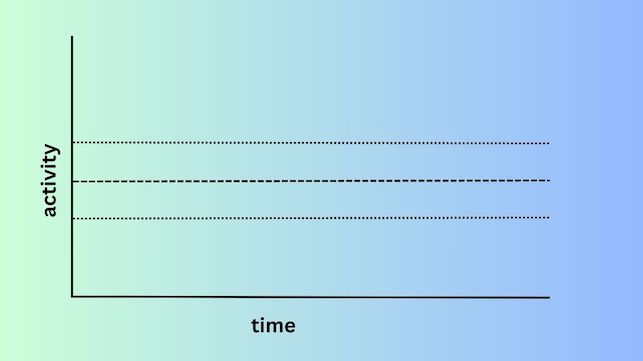
Here is a graph. The bottom line is time. The line up the side is how much energy you use. the dotted section is your happy middle where you are living moderately.
You have a little leeway up and down where you can do a bit more and be okay, or do a bit less and be okay.
Many doctors will say you must stick in this range forever and ever and you are cured. Living moderately is hard and also quite boring and soul sucking. It also isn’t a cure, you could still deteriorate if you do pacing perfectly.
Doctors may also use pacing similarly to graded exercise where they expect you to continually build upon your baseline abilities and expect you to keep improving and being able to do more and more.
Doctors often seem to think if you rest too much (so being below your minimum moderate line) you will get worse and you must keep working to improve, which is not many peoples experience, but it is also often necessary TO REST for a more successful experience pacing and a possible shot at recovery for some conditions (or at least finding and reaching a remission stage)
It’s similar how graded exercise is finally confirmed BAD for people with ME/CFS and I believe we will start seeing more evidence to support this for other long term conditions as well. We should not be pushing through ALL THE TIME especially if you feel you are not able to or will not cope well with PEM (post exertional malaise). We already have evidence to show that resting is important for preventing long COVID, or minimising the severity of the effects of long COVID.
This is how Artie explained pacing to someone recently:
I see pacing as a form of discipline in many ways.
It is the discipline of getting to know your body and it’s needs.
It is the discipline of respecting those needs and respecting when your body is telling you it has done enough.
But also pacing is and has to be flexible (which isn’t really how they talk about it as doctors)
Sometimes you do have to push yourself past that upper moderate bar to do things that will have a physical impact, so you can do things to care for your mental health.
Pacing is the balance between what your body needs and what your mental health needs, and they can conflict.
It’s about weighing up what you can handle and if it is worth it.
It’s also an important tool to find ways of doing your daily tasks that take up less energy but help your mental health so you can keep it up or do more of them.
Like if you struggle brushing your teeth twice a day, maybe go with once and a mouthwash, or a chewable one, or flossing from bed.
Learning to do make up in bed, taking breaks, finding adapted brushes or products that make it take less energy to apply, or products that do the job you need with less work. Many people find doing make up helped with their mental health but is often challenging physically.
Personal Examples of How Artie Uses Pacing
I had to really push myself out of my comfort zone to travel recently, and both whilst I was travelling and after, I’ve had to rest a lot more which lead to me not being able to do as much as I was able to do before I went away. I had to cut back on a lot of the things I usually do or am able to do so I could allow my body and mind some recovery time whilst also having to deal with the usual medical admin stressors.
I’ve not made media videos during that time because they take a lot of brain power I don’t have when I am so fatigued and in pain. Preparing for the videos as well as the sitting and filming them take more energy than other videos. The Skins Disability video took three hours of filming (an hour or two longer than normal) because I spent a lot of time struggling to string sentences together or verbalise my thoughts, as well as taking a mid filming break to lie down. So I had cut back on that content a little recently to try and allow myself some space and recovery time.
We Can’t Forget Capitalism…
There is also the issue of capitalism for many chronically fatigued and chronically pained people. Many people who need to rest or would benefit from pacing in a way that actually would work for them, can’t do that because of the world we live in. Many people can’t stop working or they will stop living/surviving. Many benefits will not cover your basic needs to live.
This is what leads to burnout, worsening health conditions and having no social life or joy because your energy goes into working so you can barely get by.
I went into more detail on the topic of capitalism and its link to how easily people can do pacing in my video on pacing, I don’t remember the specifics so if you would like to see that, feel free to give the video a watch. But these were the initial and main points.
I hope this post can be a useful resource for people, and that my video will be the same for those who prefer a video/audio format! I am always happy to update information in my blog posts, so if there is any more useful research on anything I mentioned in this post, please leave it in the comments! And do feel free to share your own experiences with pacing and what you do to make pacing work for you.
Let me know if there is anything else you’d like to share or be included in this. Please like the post and follow my blog, it supports the blog! And if you like youtube content, please check out my channel, I make a mixture of chronic illness educational content like this as well as media analysis like videos usually around disability or queerness like this blog post I wrote a little while ago about the chronic illness representation in MAFS AUS. I am working towards my goal of youtube partner, you can hear a little more about that on my new channel trailer video, your support will really help me make my dreams come to life and start my journey of being a paid content creator!
~ Artie
they/them
 artiecarden.com
Leave a comment